Showing posts with label history. Show all posts

Friday, November 11, 2011

Remembrance Day


Friday 11 November 2011

The Remembrance Day (Veteran's Day) ceremony here in Vancouver.

Monday, November 07, 2011

Poppy


Monday 7 November 2011

In the week or so leading up to Remembrance Day (Canadian Veteran's Day) everyone here wears poppies on their lapel to commemorate the veterans. And I mean, really almost every single person you see on the street.

Many of the Canadian WWI dead are buried at Flander's Fields, and now the poem "In Flanders Fields" has become so popular that it is what most Canadians associate with Remembrance Day. The poem begins "In Flanders fields the poppies blow/Between the crosses, row on row," hence the poppies worn on the lapel.

Thursday, June 03, 2010

Cistern


Thursday 3 June 2010

The old cistern under Istanbul. This was where the Romans stored water for drinking and irrigation. In those days, the water would have been right up to the top.

Friday, May 21, 2010

Plovdiv houses


Friday 21 May 2010

Back in Bulgaria, in an historical city called Plovdiv. There are lots of very nicely restored Ottoman houses here, but unlike the ones in Turkey, these are all different bright colors, and are often decorated with intricate designs above the doors and windows.

Wednesday, May 19, 2010

Red Cross Camp


Wednesday 19 May 2010

We popped over to the town of Nis (pron. "niche") in Serbia, for a few days.

Visited a WWII Nazi concentration camp while here. These were the solitary confinement cells, where prisoners were forced to sleep on floors covered with barbed wire.

I don't really know what else to say - it was upsetting as you would imagine a trip to a concentration camp would be.

Wednesday, May 12, 2010

Safranboul


Thursday 13 May 2010

Ryan and I are spending a couple of days in Safranbolu, which is an absolutely gorgeous little town a few hours from Istanbul (making us very glad it's not summer just yet . . .). The whole town has been declared a UNESCO World Heritage Site because it is so well preserved. There are hundreds of original Ottoman houses here, as well as some nice mosques, a caravansarai, and a hamam.

Thursday, April 29, 2010

Harran camel


Friday 30 April 2010

This is outside the town of Harran, which is one of the oldest continuously inhabited towns in the world.

The field there is full of stones, you might be able to see, remnants of the great capital city that used to sprawl here. (Today it is a very very small village.) We've seen fields like this in several parts of Turkey, and it is always odd to think that a huge, bustling metropolis used to cover a space that is now full of goats and camels. History seeps into every corner of this country.

Sunday, April 25, 2010

The Gazi of Antep


Monday 26 April 2010

The town of Gaziantep used to be known as just Antep. After World War I, the French tried taking the town, while attempting to extend the land they controlled in Syria. The people of Antep, however, kept the French at bay for 11 months without any help from the national army. For this heroism, the prefix "Gazi" (meaning veteran, or war hero) was added to Antep. They are often noted as being the most patriotic Turks.

These are some of the heroes of the resistance, in the Gaziantep citadel museum.

Friday, April 23, 2010

Dark Church


Saturday 24 April 2010

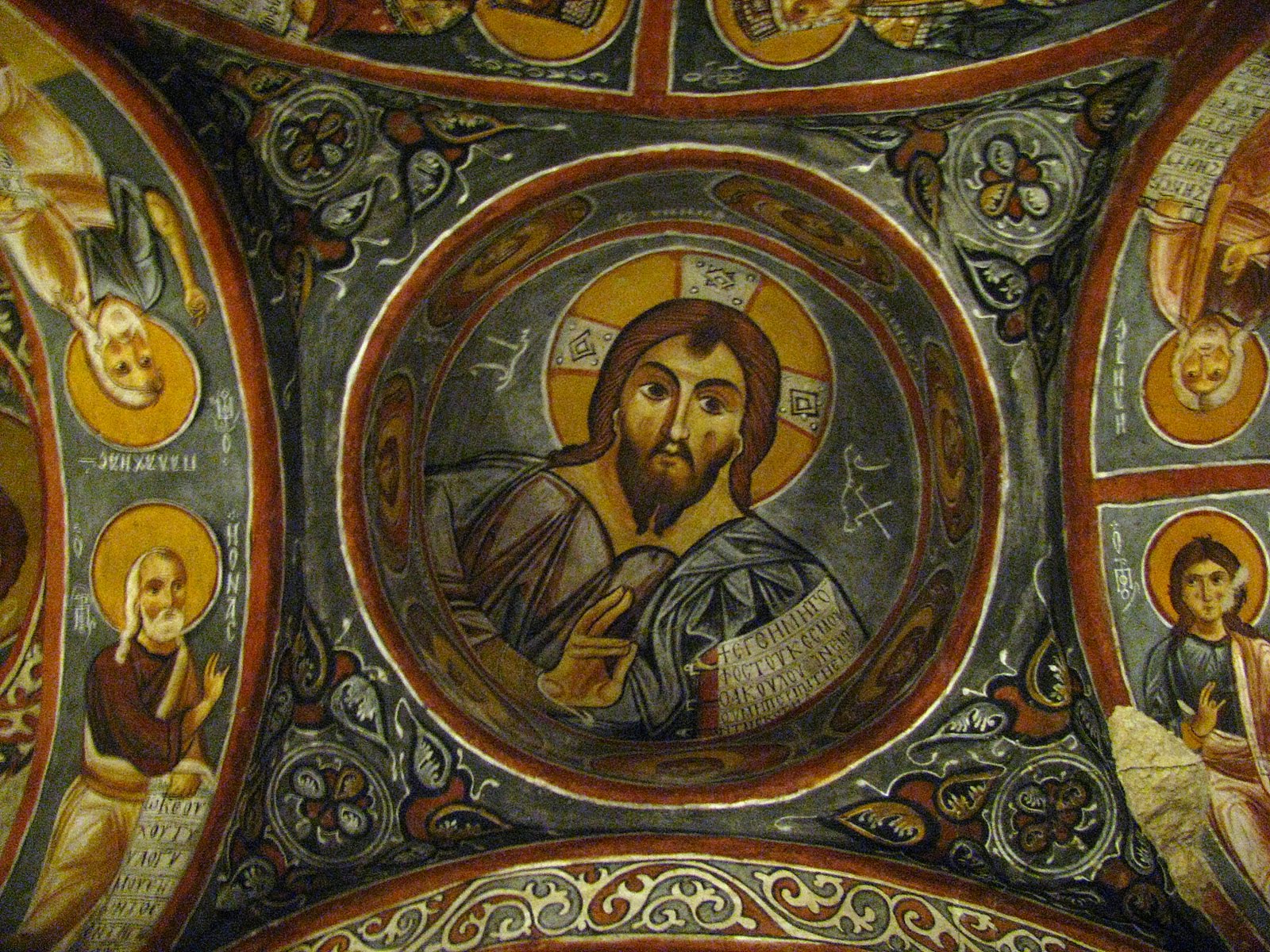
Today was a travel day, so I thought I'd show you another photo from our time in Goreme. This is the Dark Church, so called because there are no windows, making it well-protected and beautifully preserved. It is one of the cave churches carved out of the mountains in which early Christians sheltered.

Thursday, April 22, 2010

Underground city


Friday 23 April 2010

Finally had a nice day today, so we took a tour of the region. Here is a room in one of the underground cities that dot the region. Built around 2,000 years ago by the Hittites, they are best-known for being home to early Christians hiding from the Romans.

Walking through hundreds of rooms reaching down eight stories, it was hard to imagine actually living here. There was plenty of ventilation, but nothing could prevent it from being an awfully cold, damp home.

Saturday, April 17, 2010

Antalya Museum


Sunday 18 April 2010

The Antalya Archeology Museum houses an incredible collection of Roman statuary.

Wednesday, April 14, 2010

Roman Theater


Thursday 15 April 2010

There is an extremely well-preserved Roman theater just outside of Kas. Ryan and I climbed up today to watch the sun set over the mountains. What a show!

Saturday, April 10, 2010

Ottoman parade


Saturday 10 April 2010

While visiting friends here in Bursa, we caught this neat little parade of Ottoman and other traditional Turkish costumes.

Friday, April 02, 2010

Dead Sea Scrolls


Friday 2 April 2010

At the Archaeological Museum here in Amman, they have a few small pieces of the famous Dead Sea Scrolls - here's a little bit.

Super-cool, huh?

Monday, July 13, 2009

West gate


Monday 13 July 2009

Okay, one more from the weekend.

The little town where Ryan and I stayed is called HengChun, and is famous for being the only town in Taiwan to still have all four of its original city gates standing. (They were built in 1873.) We drove around and found them all. Here is the west gate, made famous by the recent Taiwanese film sensation, "Cape No.7".

Monday, May 18, 2009

Chiang Kai-Shek


Monday 18 May 2009

Okay, so I'm back in Kaohsiung today, but I couldn't resist posting one more Taipei photo. We happened upon a really cool changing of the guards at the Chaing Kai-shek memorial.

We just had to visit here, for romantic reasons. You see, Ryan and I decided to start dating under a giant statue of Chiang Kai-shek just like this one. Unfortunately, the Kaohsiung city government decided to take ours down. Ah well.

Friday, March 06, 2009

License plate


Friday 6 March 2009

Two things of note in this picture. First off, you may notice the 100 in the upper left corner - that's the year the scooter is registered until. Yes, the year 100. You see, to make things confusing, Taiwan decided to start counting from 1911 (the year in which the nation, the Republic of China, was founded). So, 1911 is year 1. This year is year 98. I was born in year 70. (Funny story - when I bought my very first cell phone here, I wrote in my birth date at just 81, instead of 1981. After a few days it still wasn't connected, so I called them up. They were waiting for a parent or guardian's signature, because they thought I was just 11 years old.) "Taiwan years" are used by almost everyone for almost everything here.

And secondly, the Chinese at the top of the plate actually says "Province of Taiwan," the same word for province that is used by China. Now, why Taiwan would imply they were a province of China, I don't know. I've asked a bunch of Taiwanese people, and no one seems to know. Very strange.

Thursday, May 08, 2008

Bolívar's Deathbed, literally


Thursday 8 May 2008

We followed the statues of General San Martín (liberator of Argentina, Chile, Uruguay, and Peru) all over the southern half of the continent, and are now up into Simon Bolívar's territory (liberator of Bolivia, Ecuador, Colombia, and Venezuela). This is the bed where he died.

Tuesday, May 06, 2008

Gabo's typewriter


Tuesday 6 May 2008

Today, I have a very special treat for all the readers out there. This is the typewriter that Gabriel García Márquez used to write A Hundred Years of Solitude. (Which is generally agreed to be the greatest novel in South American literature ever, as well as one of the best books in modern literature.)

We visited Aracataca today, which is Gabo's hometown, and also the model for Macondo, the town in A Hundred Years of Solitude. It's a sleepy small town, where the siesta is long, where things take a while to get done, where outsiders are still a curiosity. At the moment there isn't even a museum to the man considered the number one South American novelist of all time, although the post office does have this typewriter and a lot of newspaper clippings about him.

I don't know - to most of you, this probably isn't all that impressive, but I have been a huge fan of his since reading Love in the Time of Cholera in high school. It was one of the first great novels that I read and was completely sucked in by, and is still my favorite love story.

Friday, May 02, 2008

Gold Museum


Friday 2 May 2008

We visited the famous Gold Museum in Bogotá today. They're doing renovations, so we couldn't see the whole collection, but what we saw we really amazing. It's mind-boggling to think that 1, 2 thousand years ago these people had the same metal-working skills as goldsmiths today! This is a jaguar, a very important animal in the mythology of ancient Colombian cultures.